Why Music Builds Life Skills for Adults with Diverse Abilities
Rehearsing a song with other people trains habits that carry into everything else in a day.
October 13, 2026 · 4 min read
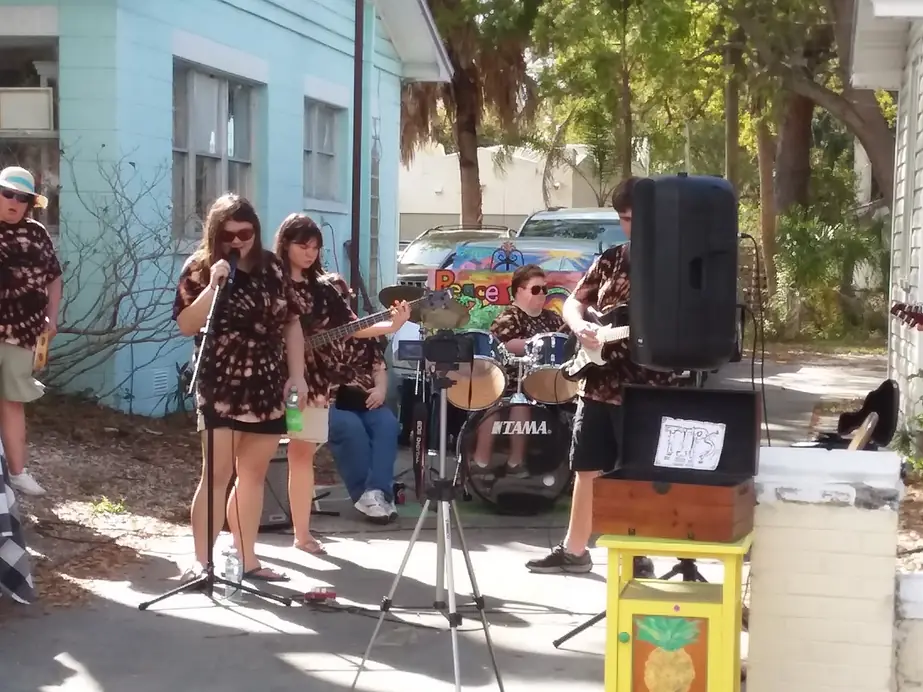
Walk into a band rehearsal and you'll hear it before you see it: someone counting in, a drummer waiting, a singer finding the first line again. It sounds like fun, and it is. It's also work, and the kind of work that teaches things adults use well beyond the music room.
Music is often treated as a pleasant extra in day programs, something for the end of the week. It can be more than that. A music program is a daily practice with clear goals, other people, a deadline and an audience. That mix is hard to build anywhere else.
Rehearsal is practice at showing up
A band can't start without its members. Learning a part means coming back to it: the same four bars on Monday, then again on Tuesday, a little better each time. That kind of repetition teaches that effort adds up, which is easy to say and surprisingly hard to feel until you've done it.
There's a particular confidence in playing something today that you couldn't play last month. It isn't praise handed over for showing up. The song either holds together or it doesn't, and everyone in the room can hear which. For adults who have spent a lot of time being told they're doing well at things that weren't hard, an honest result can feel very different.
Turn-taking, listening and memory
Ensemble playing is a lesson in waiting well. You hold back until your cue. You listen to the person beside you, adjust your volume and come in on the beat. A drummer and a bass player have to lock in with each other, and neither can do it alone.
Then there's memory. Lyrics, chord changes and the order of a set list all have to be held in your head, or in your hands. Those are the same muscles used to follow a recipe, remember the stops on a bus route, or keep track of the steps in a morning routine. Music doesn't replace those skills, but it gives people a place to practice them that they actually want to be in.
Performing adds one more thing: handling nerves. Standing in front of an audience is stressful for almost everyone. Getting through it with people who are counting on you, and then hearing the applause, teaches a person something about their own resilience that a worksheet never will.
What this looks like at ProjectFREE
Free2Rock Academy is the music program at ProjectFREE, a not-for-profit performing arts and day training program in Gulfport, Florida. According to the program, members can learn voice, guitar, drums and bass, perform at area events, and get involved in songwriting and audio and video production. ProjectFREE describes Free2Rock as the only music program of its kind.
Music is also built into the weekly schedule. The published running order for Monday to Friday is academics at 9:00, art at 10:00, lunch at 12:00 and music at 12:30, so rehearsal isn't squeezed in around the edges. It has its own slot.
The house band is called Solar Flair, an alternative rock group. Kim Costanzo, who founded ProjectFREE in 2009, says Solar Flair placed second in the Creative Loafing Tampa Bay Best of the Bay voting in 2021, and she puts the field at about 70,000 nominees. That figure is hers, from her own account. The band has also released a single, Love Is My Religion.
What to look for in any music program
Whether you're looking in Gulfport, St. Petersburg or anywhere else around Tampa Bay, a few questions separate a strong program from a pleasant activity.
First, do people choose their instrument or voice, or are they handed whatever is nearby? Second, is there a real audience at the end, not only a recital for staff? Third, is the pace set by the musicians? Good teaching meets people where they are, and then asks for a little more.
Ask also whether the music connects to the rest of the day. At its best, it does. A song written in the music room might become a poster in the art studio. A performance might be the reason someone practices reading a set list. When the skills overlap like this, they stick.
Finally, ask whether members are treated as musicians. The language matters. Someone learning bass in a band is a bass player. If a program talks about its members that way, it usually plans around them that way too.
If you'd like to hear more about Free2Rock Academy or ask whether you can sit in on a rehearsal, call ProjectFREE at (727) 603-0595 or use the contact page. They're at 2026 51st St S in Gulfport.
ProjectFREE, (727) 603-0595
Call (727) 603-0595More articles
How to Choose an Adult Day Program in Gulfport
A practical guide for families, caregivers and support coordinators weighing adult day programs around Tampa Bay.
Why Artists Keep 100% of Sales at ProjectFREE
Making art is one skill. Being paid for it, in full, is another, and it changes how the work is treated.